The Wall Street Journal recently published an article titled “Four New Jobs That May Be in Our AI Future.” https://www.wsj.com/tech/ai/new-jobs-ai-future-fefd4b35?mod=ai_lead_pos3
At first glance, it reads like a prediction about emerging job titles. But the deeper insight of the article is not about jobs at all.
It is about boundaries.
As AI systems become more capable, organizations are discovering that the hardest problems are no longer technical — they are about where responsibility, judgment, and accountability sit between humans and machines.
The four roles described in the article exist because AI does not eliminate boundaries. It creates new ones.
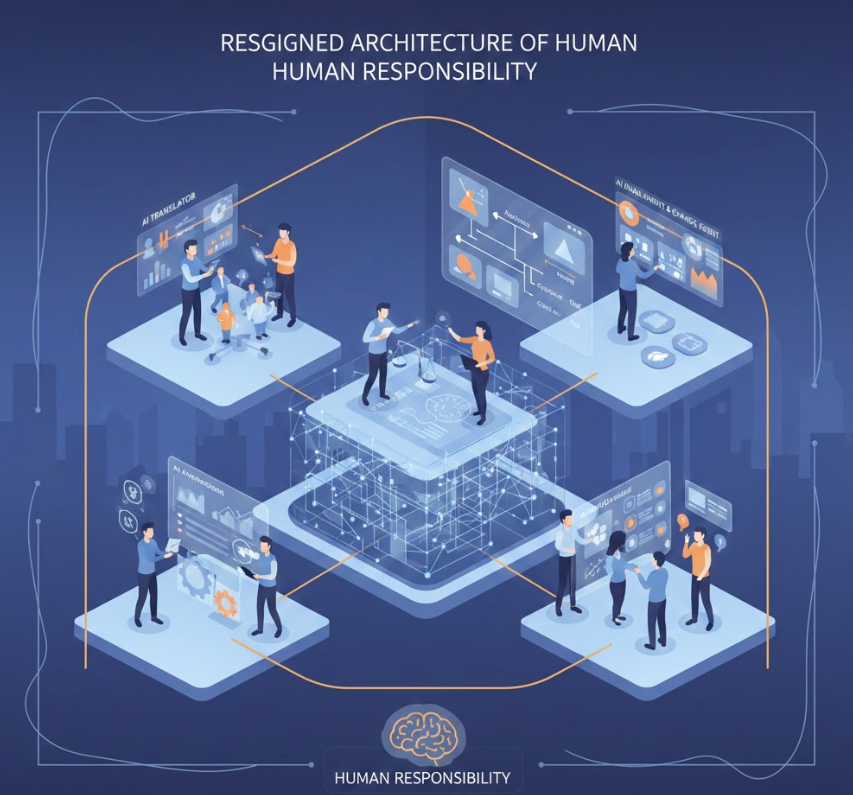
The Real Pattern: AI Creates New Boundaries That Humans Must Own
Each of the four roles in the WSJ article emerges at a critical boundary where AI alone is insufficient:
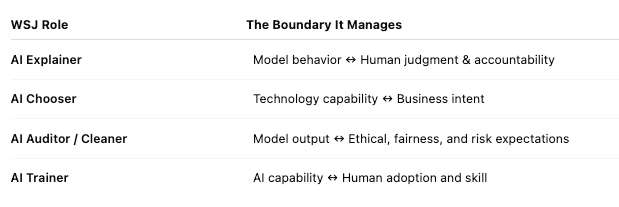
AI systems operate probabilistically, adapt over time, and increasingly influence real-world decisions. That means someone must own the space between what the AI does and what the organization is willing to stand behind. These roles are how that ownership shows up in practice.
From WSJ “New Jobs” to Industry AI Roles
To make these roles actionable for enterprises, it helps to translate them into industry-ready roles that align with operating models, governance, and scale.
From AI Explainer → AI Translator
Owning the boundary between AI output and human judgment
The WSJ describes AI explainers as people who translate complex AI systems for managers, judges, and regulators. In industry, this role is better understood as an AI Translator.
The AI Translator sits at the boundary between:
- What the model produces
- What leaders, regulators, and customers need to understand and trust
This role:
- Explains why an AI made a recommendation, not just what it said
- Connects model behavior to business, legal, and ethical implications
- Supports accountability when AI influences high-stakes decisions
AI Translators become essential in domains like:
- Credit and lending
- Healthcare recommendations
- Hiring and eligibility decisions
- Pricing, safety, and compliance-driven environments
From AI Chooser → AI Architect
Owning the boundary between technology capability and business intent
The “AI chooser” role exists because not all AI is the same — and misapplied AI is often worse than no AI at all.
In enterprises, this role becomes the AI Architect.
The AI Architect sits at the boundary between:
- What AI technologies can technically do
- What the business actually needs to achieve
This role:
- Decides where AI should be used — and where it should not
- Chooses between predictive, generative, rules-based, or hybrid approaches
- Balances speed, cost, explainability, and risk
- Designs AI as part of an end-to-end operating model, not a standalone tool
AI Architects prevent organizations from chasing hype and instead ensure AI is intentional, contextual, and scalable.
From AI Auditors & Cleaners → Responsible AI & AI Operations
Owning the boundary between AI behavior and acceptable risk
The WSJ groups auditors and cleaners together, but in practice they form the backbone of Responsible AI and AI Operations.
These roles sit at the boundary between:
- What the model is doing in production
- What the organization considers fair, compliant, and acceptable
This boundary exists because AI risk is not static.
Models drift. Data changes. Feedback loops emerge. Bias can appear months after deployment.
AI Auditors:
- Continuously monitor performance, bias, and drift
- Validate outcomes across populations and time
AI Cleaners (or Operators):
- Retrain or recalibrate models
- Adjust constraints, features, or thresholds
- Intervene when systems operate outside guardrails
Together, these roles turn AI governance from a one-time review into an ongoing operational discipline.
From AI Trainer → AI Enablement & Change Agent
Owning the boundary between AI capability and human adoption
The final role in the article addresses a truth many organizations learn too late. The biggest risk in AI is not model failure — it’s adoption failure.
In industry, the AI trainer becomes an AI Enablement or Change Agent.
This role sits at the boundary between:
- What AI can theoretically do
- What people are actually ready to use and trust
AI Enablement focuses on:
- Teaching people how to work with AI, not just how to use tools
- Helping employees question, validate, and apply AI outputs
- Using AI itself to personalize learning and upskilling
- Embedding AI into daily workflows instead of one-off pilots
Without this role, even the best AI systems stall.
The Bigger Insight: AI Is Forcing a Redesign of Human Responsibility
The WSJ article may frame these as “new jobs,” but the deeper message is this:
As AI systems become more powerful, humans move closer to ownership of decisions — not farther away.
Across industries, we are seeing a new human architecture emerge — one defined by boundary ownership:
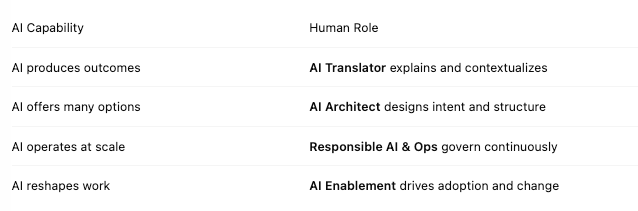
Organizations that fail to intentionally design these roles will still need them — but they will emerge informally, inconsistently, and reactively.